A program that invites listeners to follow a single musical idea as it unfolds, deepens, and transforms across time. Spanning composers, epochs, and styles, these works trace the evolution of the singing bass line into a fully expressive, independent voice—across three centuries and refracted through changing keyboard roles. Anchoring the program is Johann Sebastian Bach, Token Creek’s north star, whose music establishes both the structural DNA and the program’s expressive premise. From this foundation, the program explores works by composers who inherit and transform Bach’s conception of line, counterpoint, and instrumental voice: Harbison’s contemporary reflections on the lineage, heard in context of the intermediaries of Debussy and Prokofiev.
Cellist Robert Burkhart, known as “the adventurous cellist” (The New Yorker), and pianist Avedis Manoogian—close friends since their student days, their musical connection undimmed across time—reunite in Madison for this richly varied and expansive program.
Program
BACH | Sonata in G major for Viola da Gamba & Keyboard, BWV 1027 (ca. 1720)
SHAW | in manus tuas (2009)
DEBUSSY | Sonata for Cello and Piano, L.135 (1915)
BACH | Adagio from Toccata, Adagio and Fugue in C Major, BWV 564 (ca. 1717)
HARBISON | Piano Sonata No. 3 (2020)
PROKOFIEV | Cello Sonata in C Major, Op. 119 (1949)
The Artists
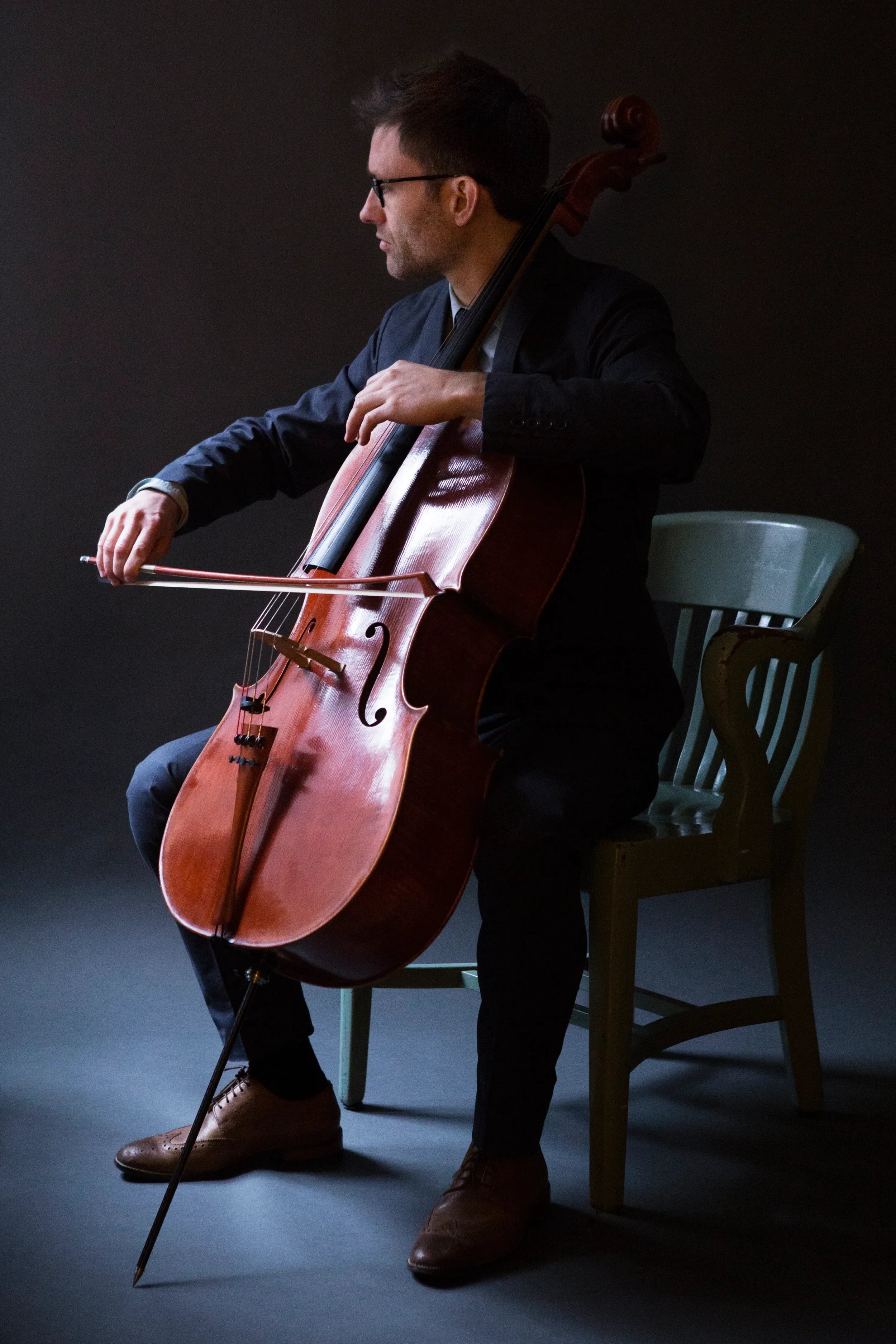
Cellist Robert Burkhart combines a deep commitment to the existing cello repertoire with what the New Yorker magazine calls an “adventurous” spirit in new music. With performance credits at Alice Tully Hall, Bargemusic, Carnegie Weill Recital Hall, Merkin Hall, and The Rose Studio at Chamber Music Society of Lincoln Center, Robert has also appeared as a soloist throughout Japan as a member of the New York Symphonic Ensemble, and been featured in recital on WQXR’s “Young Artist Showcase.”
At the center of new music in New York, Robert has performed with the American Modern Ensemble, Argento New Music Project, Fireworks Ensemble, Newspeak, and SONYC. Recent collaborations include Uri Caine, Georg Friedrich Haas, Aaron Jay Kernis, Steve Mackey, Joan Tower, Charles Wourinen, and Chen Yi. He has performed the New York premiere of John Harbison’s Abu Ghraib for cello and piano, and was the soloist in Augusta Read Thomas’s Passion Prayers for cello and chamber ensemble at the New York Times Center.
Robert’s major teachers include Paul Tobias at The Mannes College of Music and Uri Vardi at University of Wisconsin-Madison, and he has worked with Timothy Eddy, Aldo Parisot, and Janos Starker at festivals and masterclasses. Robert has taught at Juilliard Pre-college, Mannes Prep, Syracuse University, and Music Conservatory of Westchester, and been artist-in-residence at Yale University and the Banff Centre for the Arts in Canada. His recent CD “20/21: Music for Cello and Piano from the 20th and 21st Centuries,” features pianist Blair McMillen and the premiere of a work for cello and piano by composer Andrew Waggoner. Robert’s recording of solo Bach on the American Express commercial “Don’t Take Chances. Take Charge.” has garnered national attention. https://robertpburkhart.com/
Pianist Avedis Manoogian has pursued a wide-ranging musical career as performer, composer, improviser, teacher, and theater musician. Raised in a uniquely creative musical household, his parents—violin virtuoso Vartan Manoogian, and imaginative visual artist Brigitte Manoogian—instilled both technical rigor and artistic curiosity from an early age.
Manoogian began formal musical training with pianist and John Cage scholar Ellsworth Snyder, and later with Nina Svetlanova. At the University of Wisconsin–Madison he studied with Carroll Chilton, followed by advanced work in Minneapolis with Margo Garrett and Timothy Lovelace. His career has taken him from the concert stage to the theater, encompassing work as a soloist, collaborative pianist, music director, composer, and educator.
Collaboration with living composers has been a recurring thread throughout his artistic life. American composers with whom he has worked include Joel Naumann, whose complete piano works he recorded, and John Downey, who expanded a student composition into a three-movement sonata after hearing Manoogian perform Night Piece for violin and piano. In 2005 he performed with the legendary composer and innovator Roscoe Mitchell, a formative musical influence since childhood. In 2008 he joined composer John Harbison in a program pairing Kurtág’s Bach transcriptions with selections from Bach’s Art of Fugue, and he continues exploring Harbison’s music in his solo and chamber work.
Equally committed to teaching, Manoogian has worked with developing string players at Wisconsin String Academy, MacPhail Center for the Arts, Cincinnati Suzuki Cooperative, the Marion Peraza String Workshop. Recently returned to Madison, he now teaches piano, music theory, analysis, and college preparation at Madison Conservatory, and serves on the faculty of WYSO Music Makers, and is staff pianist for Suzuki Strings of Madison.
Manoogian’s work continues to explore the intersections of classical music, jazz, improvisatory chamber music, theater, and collaborative performance.
Notes
A program that traces a single idea across three centuries: the bass voice — harmonic foundation, contrapuntal anchor, structural bedrock — gradually claiming the role of melodic protagonist.
Johann Sebastian Bach opens both program halves. The G major Gamba Sonata (BWV 1027) presents a world already fully realized — the bass instrument lyrical, agile, conversational, the keyboard a genuine equal rather than mere continuo support. The two instruments move in a kind of ideal counterpoint: neither leads nor follows for long, and the exchange feels less like accompaniment than like thought made audible between two minds. The Adagio from BWV 564, originally for organ, distills something more inward and suspended: an improvisatory meditation where harmonic motion and melodic line become inseparable, the voice ornamented and rhapsodic, hovering as if reluctant to resolve. Together these two Bach works establish the program's twin poles — dialogue and introspection — that every subsequent work inhabits and explores in its own way.
Caroline Shaw's in manus tuas (2009) — the title drawn from a Renaissance motet by Thomas Tallis — carries that introspective quality into the present. Its spare textures and vocal quality of line suggest a continuous thread between early polyphony and contemporary composition, as if the intervening centuries were simply a long breath. Debussy's Cello Sonata (1915) acts as prism: stripping texture to its essentials, treating gesture, color, and silence as structural elements. Its economy and avoidance of Germanic development reimagine what "line" can mean — less a continuous thread than a sequence of evocative utterances, each one self-contained and luminous. In this context Debussy becomes a crucial intermediary, standing between Bach's architecture and everything that follows.
After intermission, the program opens outward and shifts its center of gravity. Harbison's Piano Sonata No. 3 (2020) moves the voice entirely to the keyboard — now not partner but protagonist, the piano's left hand carrying the lineage of the bass voice into a modern, searching idiom. Harbison does not merely reference Bach's premises; he inhabits them, translating inherited structural logic into a contemporary personal language that is at once rigorous and deeply felt.
And then Prokofiev. The C major Sonata (1949) restores breadth and lyricism with a distinctly modern edge: the cello sings expansively and at length, often against a piano part that is by turns percussive, ironic, tenderly supportive, and darkly propulsive. Written under the constraints of late Stalinism yet suffused with resilience and even warmth, it offers something like reclamation — the long melodic span returned to the cello, but now charged with everything the 20th century had put it through. If Bach shows us the ideal and Debussy and Shaw refract it into new light, Prokofiev earns it back.
Heard together, these works form a continuous arc: the bass voice moves from Baroque foundation to lyrical protagonist, while the keyboard evolves from equal partner to independent poetic voice — and, in Prokofiev, back to something like equals again, tested and changed by the journey.