KONTRAS QUARTET boldly explores the evolving role of chamber music in the new millennium. Equally committed to time-honored classics, contemporary compositions, and genre-blending collaborations, Kontras strives to continually enrich the string quartet art form and champion diverse voices. Formed in 2009, the "superb Chicago-based ensemble" (Gramophone Magazine) has become known for its vibrant and nuanced performances, “crisp precision" (Palm Beach Daily News), and "superlative artistry" (CVNC Arts Journal). Their Token Creek program offers a study in inner lives — the stories we tell ourselves about love, loss, and the limits of language. Across five works spanning nearly two centuries, each composer turns to the string quartet not as a vehicle for public declaration but as something more intimate and more dangerous: a space where private experience struggles toward form.
Critical acclaim
"To say that the playing was impressive would be an understatement. The performance was full of life, clean, crisp, and vibrant. With tonight's performance, it is evident that the Kontras Quartet has worked hard and has become a tightly crafted and beautiful instrument." - CVNC Arts Journal
"For their debut recording, the superb Chicago-based ensemble have eschewed anything resembling the predictable. As in everything on their inaugural disc, the Kontras players are alert to the minutest facets. How they apply such care and personality to core repertoire will be fascinating to hear..." - Donald Rosenberg, Gramophone
"The Kontras Quartet has a distinctive and enjoyable musical personality.” - Fanfare Magazine
Program
JOHN ELMQUIST | Sacred Traces (2017)
STACY GARROP | String Quartet No. 1 (1992)
LEOŠ JANÁČEK | String Quartet No. 1, "Kreutzer Sonata" (1923)
PHILIP GLASS | String Quartet No. 2, "Company" (1983)
ROBERT SCHUMANN | String Quartet No. 3 in A major, Op. 41 (1842)
Join us for a reception after the concert and greet the artists.
The Artists
KONTRAS QUARTET boldly explores the evolving role of chamber music in the new millennium. Equally committed to time-honored classics, contemporary compositions, and genre-bending collaborations, Kontras strives to continually enrich the string quartet art form, expand audiences, and champion diverse voices. Formed in 2009, the "superb Chicago-based ensemble" (Gramophone Magazine) has become known for its vibrant and nuanced performances, “crisp precision" (Palm Beach Daily News), "superlative artistry" (CVNC Arts Journal), and a passion for exploring the folk roots of classical music. Kontras’s "enjoyable musical personality" (Fanfare Magazine) and welcoming, friendly approach to the recital stage have attracted audiences near and far for over fifteen years. Kontras means ‘contrasts’ in the Afrikaans language - fitting for a string ensemble whose colorful repertoire spans centuries, genres, and continents. In addition to a robust national and international performing and touring schedule, Kontras Quartet has released five critically acclaimed albums, most recently 2024’s “All Made of Stories” on MSR Classics. The group’s first album, “Origins”, also on MSR classics, was commended by Gramophone Magazine for the quartet’s "scrupulous shading and control." Kontras has released three albums in collaboration with the bluegrass trio, the Kruger Brothers: Lucid Dreamer, Roan Mountain Suite, and Moonshine Sonata, all on Doubletime records. The unique Kontras/Kruger pairing has become beloved by audiences all over the world, including those at the Telluride and Merlefest festivals, as well as on Late Night with David Letterman with special guest banjoist Steve Martin. All four members are passionate teachers, holding positions at Elmhurst University. The group holds short-term residencies and gives regular masterclasses and clinics at institutions throughout the United States. www.kontrasquartet.com
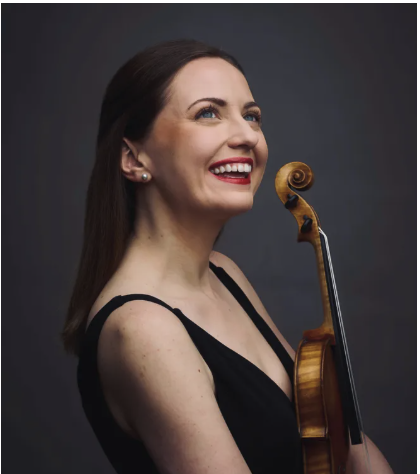
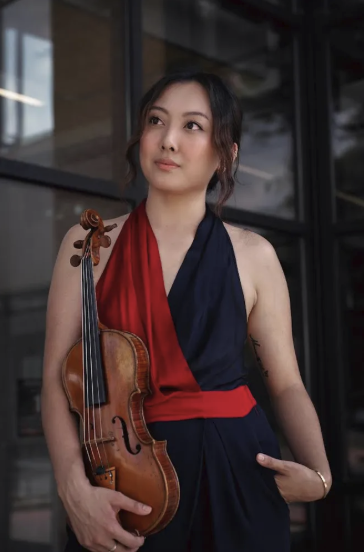
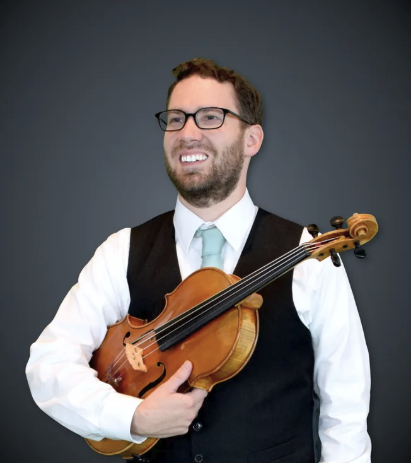
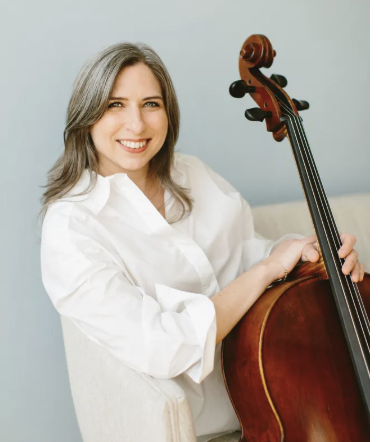
Read our interview with Eleanor Barsch here.
Listen to KQ
Notes
Kontras Quartet’s program offers a study in inner lives — the stories we tell ourselves about love, loss, and the limits of language. Across five works spanning nearly two centuries, each composer turns to the string quartet not as a vehicle for public declaration but as something more intimate and more dangerous: a space where private experience struggles toward form.
The program moves from the compressed spiritual intensity of John Elmquist's Sacred Traces, through the raw emotional directness of Stacy Garrop's first quartet, into the psychological violence at the heart of Janáček's Kreutzer Sonata, then into Philip Glass's luminous stillness, and finally to the exuberant, searching energy of Schumann's third quartet. If there is an overall shape to the program, it might be this: from fragmentation toward wholeness, from distress toward something like joy.
Two works carry a Chicago connection close to the ensemble's own story. Stacy Garrop, who resides in Chicago, is now a cherished friend of the Kontras Quartet. John Elmquist wrote Sacred Traces as a gift for Kontras, attempting to capture something of what this ensemble means to the people who know them.
JOHN ELMQUIST: Sacred Traces (2017) Written for the Kontras Quartet LISTEN
John Elmquist belongs to the Chicago new music community as both composer and thoughtful collaborator, and Sacred Traces emerged from his relationship with this ensemble — music written not for an abstract "string quartet" but for these four specific musicians and their singular expressive world.
The title suggests both the spiritual and the archaeological: a sacred trace is something left behind, an imprint of the transcendent on the material world. Elmquist's music dwells in that threshold, exploring how fleeting moments of intensity — a texture, a gesture, a harmonic color — leave traces that accumulate into meaning. The work is less concerned with traditional development than with presence and resonance, asking what remains after a sound fades.
Sacred Traces opens the program with a kind of invocation, preparing the ear and the imagination for the program that follows.
STACY GARROP: String Quartet No. 1 (1992) LISTEN
Stacy Garrop wrote her first string quartet while a student in Chicago, at the very beginning of what has become a distinguished compositional career — one defined by emotional directness, formal intelligence, and a gift for writing music that reaches audiences viscerally even as it rewards close analytical attention. That she has since become a friend of the Kontras Quartet gives this performance a particular warmth: the ensemble is not merely playing a piece but honoring a relationship and a shared artistic home.
The first quartet bears the hallmarks of a young composer who already knows what she wants to say. Garrop's musical language here is chromatic and intense, with a rhythmic vitality that keeps the music in constant forward motion even during its most lyrical passages. There is an urgency to the work — a sense that something important is being worked out in real time — that anticipates the emotional ambition of her later music.
String Quartet No. 1 shows up Garrop’s singular voice, already her own in this youthful work.
LEOŠ JANÁČEK: String Quartet No. 1, "Kreutzer Sonata" (1923) LISTEN
Janáček was nearly seventy when he wrote this quartet, and it burns with the ferocity of a much younger man. The title refers to Tolstoy's novella of the same name, in which a jealous husband murders his wife — and to Beethoven's violin sonata that serves as Tolstoy's catalyst for sexual obsession and destruction. But Janáček's relationship to his source material is neither illustration nor commentary. It is something more personal and more unsettling.
By 1923 Janáček had fallen into a consuming, largely epistolary passion for a married woman named Kamila Stösslová — a relationship that would fuel nearly everything he wrote in his final decade. The Kreutzer Sonata quartet is at once about Tolstoy's doomed characters, about Janáček's own longing, and about the general condition of eros as a force that exceeds any vessel trying to contain it. The result is music of jagged, raw, almost violent emotional intensity.
Janáček's late style is one of the most distinctive in the repertoire: short, obsessively repeated motivic cells that build pressure without release; sudden lurches in register; abrupt silences; a harmonic language that owes almost nothing to his Viennese contemporaries. The quartet does not so much develop themes as accumulate states of feeling, each one pressing urgently against the next. It is uncomfortable music, by design.
PHILIP GLASS: String Quartet No. 2, "Company" (1983) LISTEN
Where Janáček scorches, Glass illuminates. Company was written as incidental music for a Samuel Beckett prose piece of the same name — a meditation on memory, voice, and the difficulty of knowing whether one is the subject or object of one's own experience. Beckett's Company circles the question: whose voice is it that speaks to you in the dark?
Glass's response is characteristically austere and, in its austerity, quietly devastating. The work unfolds in the language of minimalism — cycling arpeggios, slowly shifting harmonies, a texture that seems to breathe in long, meditative phrases — but within that language Glass achieves something that transcends mere pattern. Company is contemplative music that creates a genuine interior space, an emptiness that is not absence but openness.
On a program concerned with emotional extremity, Glass provides a still point. Coming after the volcanic energy of the Janáček, Company asks the listener to sit with uncertainty rather than resolution.
ROBERT SCHUMANN: String Quartet No. 3 in A major, Op. 41, no. 3 (1842) LISTEN
In the summer of 1842 — newly married to Clara Wieck, in a period of relative personal stability — Schumann turned to the string quartet with an almost studious intensity, immersing himself in the Beethoven quartets and then producing three of his own in rapid succession. The third quartet, in A major, is the crown of the set: the most formally assured, the most emotionally various, and the most purely joyful.
The Op. 41 quartets are sometimes described as Schumann's attempt to prove himself in the chamber medium after years of focusing on piano music and song. But the third quartet feels like more than a proof of competence — it feels like a composer discovering what the genre can do for him specifically. The first movement's expansive themes, the slow movement's tender lyricism, the scherzo's mercurial energy, and the finale's exuberant momentum all carry the unmistakable stamp of a mind thinking in melody and harmonic surprise.